Walletx-batch swap flow
Walletx-batch swap flow
Walletx-batch swap flow
Overview
Overview
WalletX is a Solana-based wallet concept designed to make DeFi interactions simple, fast, and easy to understand.
While most wallets let you send, receive, and swap tokens, they often feel fragmented — especially when managing multiple assets.
This concept focuses on improving the swapping experience, introducing a Batch Swap flow that lets users exchange multiple tokens into one governance coin in a single, intuitive step.
The goal was to remove repetitive actions and create a flow that feels smooth, predictable, and familiar, even for users who’ve never used batch swapping before.
WalletX is a Solana-based wallet concept designed to make DeFi interactions simple, fast, and easy to understand.
While most wallets let you send, receive, and swap tokens, they often feel fragmented — especially when managing multiple assets.
This concept focuses on improving the swapping experience, introducing a Batch Swap flow that lets users exchange multiple tokens into one governance coin in a single, intuitive step.
The goal was to remove repetitive actions and create a flow that feels smooth, predictable, and familiar, even for users who’ve never used batch swapping before.
The Challenge
The Challenge
DeFi users often hold multiple tokens from different protocols or airdrops.
When they want to convert those tokens into one governance coin (like SOL… etc), they usually have to swap each token one by one, repeating the same flow multiple times.
It’s not just time-consuming, it also creates friction.
Each swap means another confirmation, another transaction fee, and more waiting.
For a space that prides itself on “efficiency,” this process didn’t feel efficient at all.
I wanted to solve that — not by inventing something entirely new, but by refining the user flow so it feels effortless and familiar.
DeFi users often hold multiple tokens from different protocols or airdrops.
When they want to convert those tokens into one governance coin (like SOL… etc), they usually have to swap each token one by one, repeating the same flow multiple times.
It’s not just time-consuming, it also creates friction.
Each swap means another confirmation, another transaction fee, and more waiting.
For a space that prides itself on “efficiency,” this process didn’t feel efficient at all.
I wanted to solve that — not by inventing something entirely new, but by refining the user flow so it feels effortless and familiar.
The Solution
The Solution
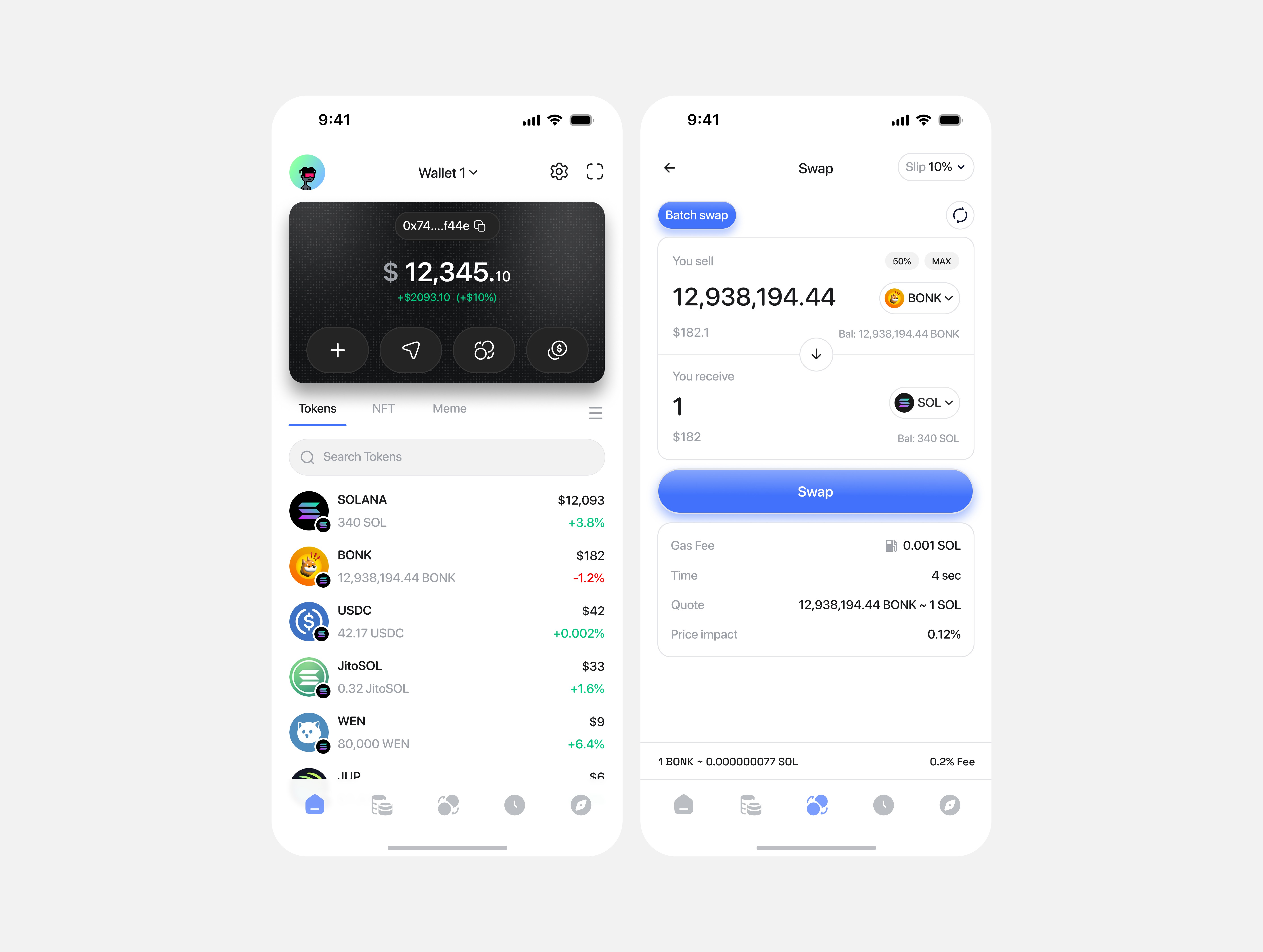
I introduced the Batch Swap flow directly inside the main Swap screen, so users don’t have to go somewhere else or learn a new feature.
Here’s how it works:
The Batch Swap button sits clearly above the regular swap component — always visible, but not intrusive.
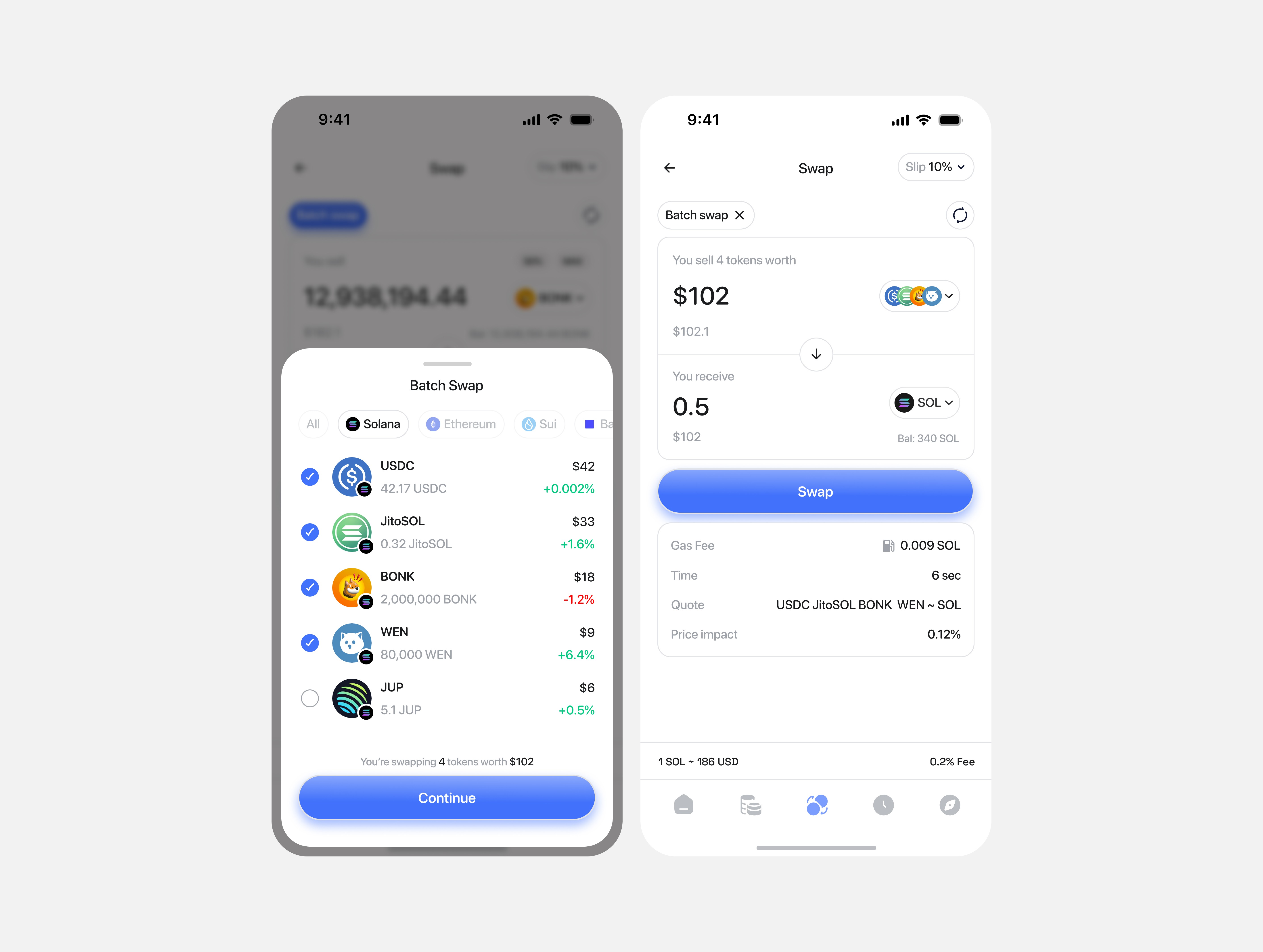
When tapped, it opens a bottom sheet where users can pick multiple tokens to swap at once.
After selecting tokens, they hit Continue, and the main swap screen updates to show all chosen tokens under the “You Pay” section.
The total swap value updates in real time, giving clear visual feedback before confirmation.
If users change their minds, they can easily exit batch mode by tapping the button again — (which is now now turned into a cancel icon.
The focus was on reducing steps, keeping the flow intuitive, and maintaining full control at every stage.
I introduced the Batch Swap flow directly inside the main Swap screen, so users don’t have to go somewhere else or learn a new feature.
Here’s how it works:
The Batch Swap button sits clearly above the regular swap component — always visible, but not intrusive.
When tapped, it opens a bottom sheet where users can pick multiple tokens to swap at once.
After selecting tokens, they hit Continue, and the main swap screen updates to show all chosen tokens under the “You Pay” section.
The total swap value updates in real time, giving clear visual feedback before confirmation.
If users change their minds, they can easily exit batch mode by tapping the button again — (which is now now turned into a cancel icon.
The focus was on reducing steps, keeping the flow intuitive, and maintaining full control at every stage.
Design process
Design process
I started by studying how popular Solana wallets like Phantom and Backpack handle token swaps.
They all made users swap tokens one by one, a simple flow but inefficient for people managing multiple assets. That insight defined the core problem: too many repetitive steps for a single goal.
After that, I sketched out a few wireframes to explore how batch swaps could fit into the existing flow without feeling like a separate feature.
Finally, I explored different entry points and ended up integrating a Batch Swap button directly into the main swap interface. From there, users can select multiple tokens, review totals, and confirm everything in one smooth flow.
I started by studying how popular Solana wallets like Phantom and Backpack handle token swaps.
They all made users swap tokens one by one, a simple flow but inefficient for people managing multiple assets. That insight defined the core problem: too many repetitive steps for a single goal.
After that, I sketched out a few wireframes to explore how batch swaps could fit into the existing flow without feeling like a separate feature.
Finally, I explored different entry points and ended up integrating a Batch Swap button directly into the main swap interface. From there, users can select multiple tokens, review totals, and confirm everything in one smooth flow.
Final Designs
Final Designs